The Everett Herald
Published on October 27, 2023
As the days of Rod Drivstuen at quarterback passed, Bearcat football struggled to find itself in the ensuing years. From 1978 to 1985, Monroe had only one winning season and experienced its first winless season in 1982. With major changes needed, Rollin Wilson departed after 1983 and was replaced by Kurt Nowadnick. During his third year at the helm in 1986, Coach Nowadnick guided Monroe to a breakout year as the football program gained new life. With Monroe beginning to rise as a powerhouse in the WESCO conference, a young quarterback emerged to stake a claim among Washington’s greatest quarterbacks of the era.
Carrying on the Success

Courtesy of Kurt Nowadnick
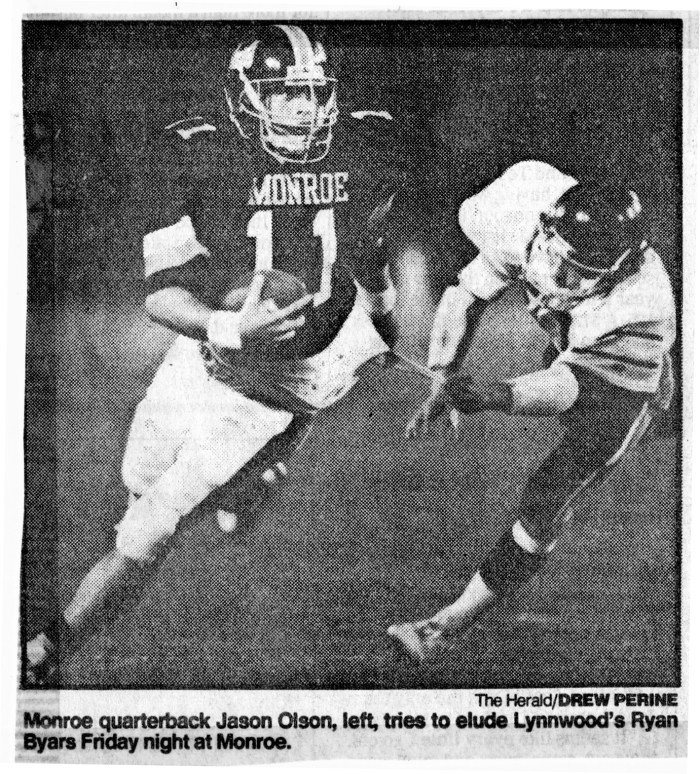
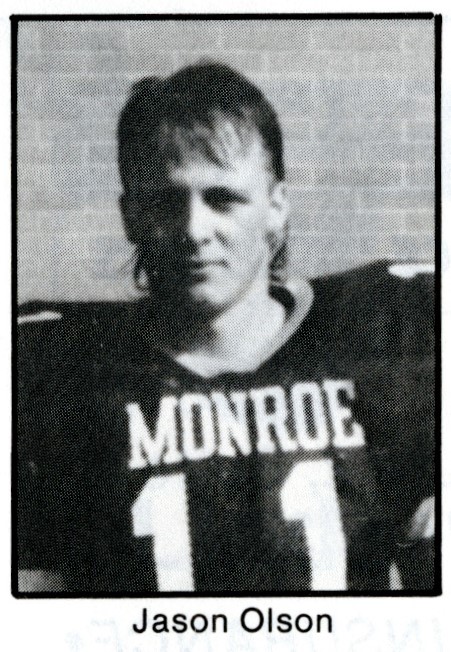
The 1986 season was the long-awaited resurgence Monroe fans had hoped for. A group of talented Seniors led the Bearcats to an 8-2 record and the program’s first appearance in the State Playoffs. As the season ended, Monroe faced the difficult task of replacing their star quarterback Rod Pope after his graduation. With few options in the program, Coach Nowadnick chose Jason Olson, a sophomore, to become the team’s quarterback in 1987. Though he was inexperienced, Olson flashed his talent throughout his first season.
The Everett Herald
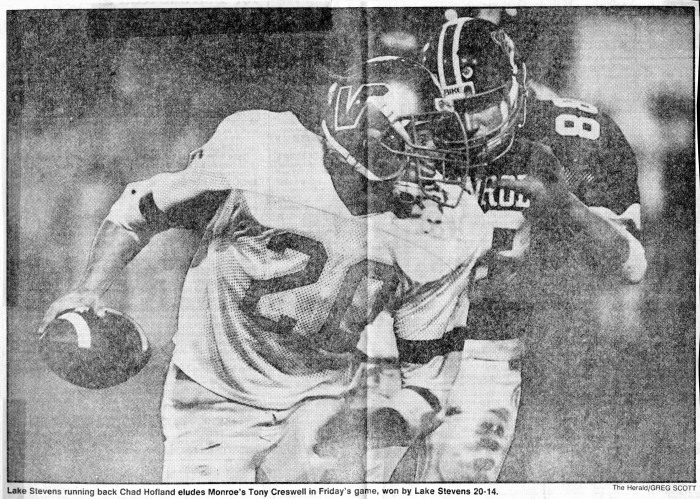
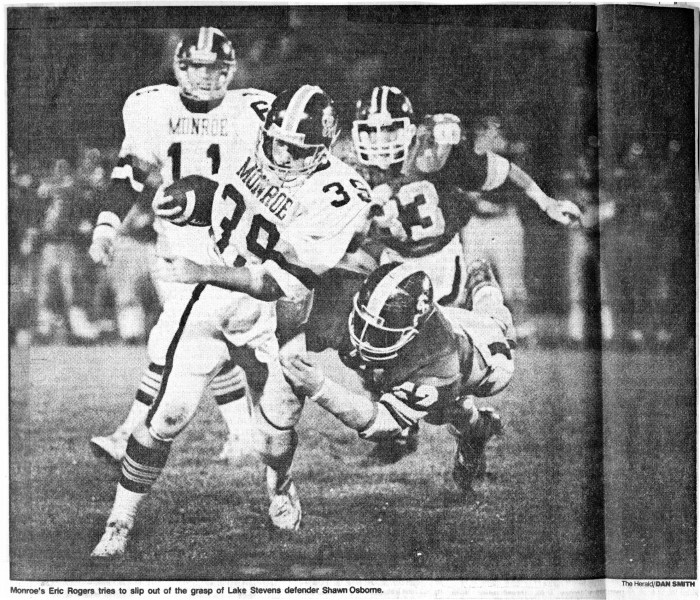
During a late season rivalry game against Lake Stevens, Olson battled a tough Vikings defense throughout the contest and led a potentially game-winning drive down the field with less than a minute left. The Bearcats advanced to within the Lake Stevens 24-yard line with two seconds remaining before Olson’s final pass was deflected away by Vikings defenders.[1] Despite the offense averaging seven less points than in 1986, the defense carried the team to a second straight berth in the state playoffs and a 7-4 record. Now seasoned with a year of experience, Jason Olson retained the starting quarterback role in 1988. Though his talent was evident to all, few could have predicted that Olson would spend the next two seasons carving his name into the Monroe record books.
Rewriting History
The Everett Herald
The 1988 season began promisingly as Monroe defeated Eastmont in a low-scoring contest. The following week against West Valley in Yakima, Jason Olson began to make history. The game ended in a 37-22 loss but Jason showed off his passing ability by throwing for 303 yards, a total that set a single-game school record.[2] After a week three loss to Bainbridge, Olson and the Bearcats hit their stride as a team. Monroe defeated three teams in a row to set up for another critical matchup against Lake Stevens. The Viking defense limited Olson’s passing yardage but his two touchdown passes proved to be decisive as the Bearcats won 14-12.[3] With the Viking’s playoff hopes dashed, Monroe seemed primed to continue the winning streak the rest of the season.
Unfortunately for the Bearcats, a loss to Woodway the following week ended any chances of returning to the playoffs. Despite missing out on playing for the state title, the season ended on a high note as Monroe routed Mountlake Terrace 34-6 and Olson set more records. Jason set single-season records with 1,102 passing yards and 13 touchdown passes. His 74-yard pass to Merritt Wolfkill was also the longest pass completion in school history.[4] Olson had officially become a star in Monroe but was becoming recognized as one of state’s best quarterbacks
One of Washington’s Finest
Courtesy of Kurt Nowadnick
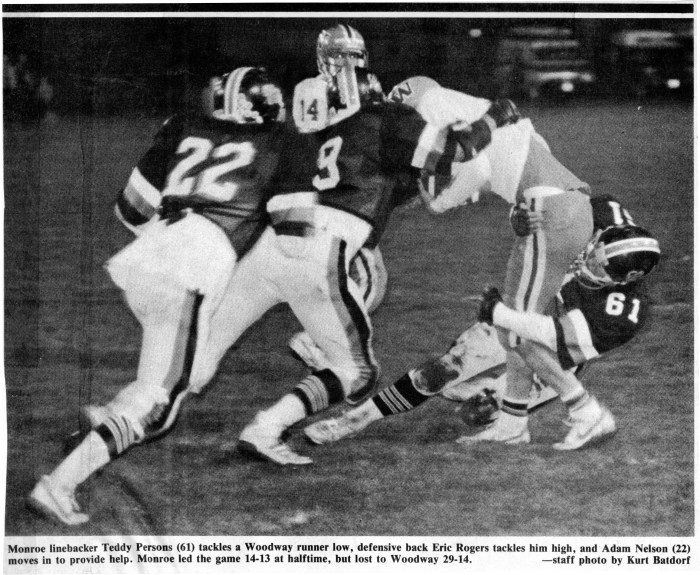
The 1989 season got off to a rough start for Monroe as the team lost two straight games, including a 40-13 beatdown by Central Kitsap to open the year. The opening season funk soon departed as the Bearcats defeated Lynnwood in a close game during Week 3. The next week, Monroe traveled to Lake Stevens for another highly anticipated matchup. Lake Stevens appeared to be the stronger team as the Vikings were ranked #6 in the state polls and boasted a strong defensive secondary. However, Jason Olson proved his star pedigree by orchestrating an upset with one of his greatest performances.
The highly-touted Viking secondary proved to be no match for Olson’s passing attack as he completed 16 of 26 passes, racking up 201 yards and two touchdown passes. He also added a rushing touchdown and recovered a Lake Stevens fumble while playing on defense as the Bearcats cruised to a 31-19 victory. In an article about the game, longtime Lake Stevens sports writer Mike Anderton spoke highly of Monroe’s quarterback. “The defensive secondary was supposed to be one of Lake’s strengths this season,” said Anderton. “But against Jason Olson…it made no difference at all.” Anderton continued to praise Olson as he wrote that Jason had “quick feet, strength, accurate arm, and the ability to pick out receivers – the whole package that makes for a great quarterback, tied together with competitive fire.”[5]
The Everett Herald
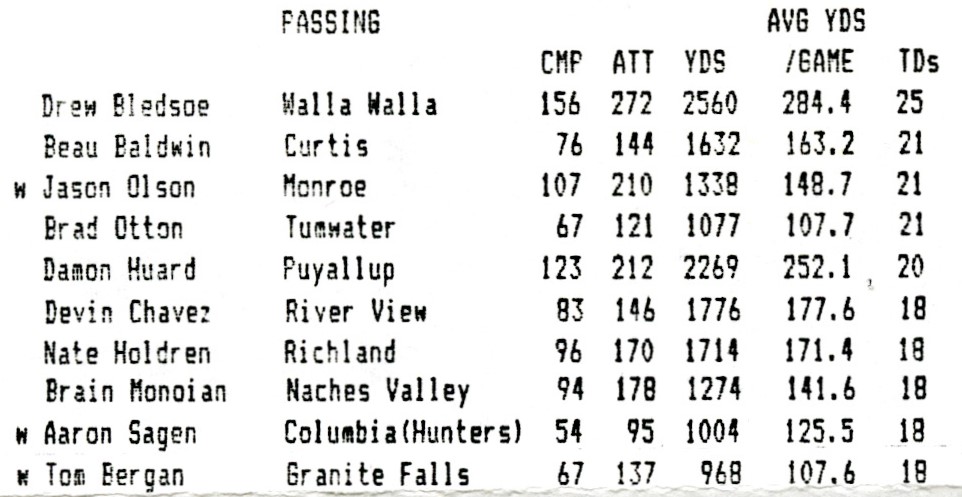
After beating Lake Stevens, Monroe continued its surge as the Bearcats defeated Mountlake Terrace and Woodway. Despite the four-game winning streak, Monroe lost its last two of three games, losing the chance to capture the WESCO title. The Bearcats still managed to play well enough to earn a chance to play in the state playoffs as they faced Burlington-Edison in the State Qualifying Round. In a tightly fought contest, Monroe pulled out a 28-26 win as Olson keyed the victory with 238 passing yards and two touchdown passes.[6] Despite falling to a powerful O’Dea team in the state playoffs, the Bearcats season was a success thanks in large part to Olson’s record breaking campaign. He once again rewrote Monroe’s single season records by passing for 1,295 yards and 18 touchdowns. Olson also set a single-game record by throwing four touchdown passes.[7] Statistics from the O’Dea game are unavailable but after Burlington-Edison, Olson had thrown for 1,533 yards and at least 21 passing touchdowns.
Courtesy of Kurt Nowadnick
These statistics were excellent not only in Monroe but also the state of Washington as Jason found himself in elite company. After the Burlington-Edison game, Olson was tied with Beau Baldwin, a future star at Central Washington University, for second place in touchdown passes. Jason’s number passing touchdown passes surpassed that of Damon Huard, who later became a starter at the University of Washington. Olson only trailed the future Washington State University legend and New England Patriots quarterback Drew Bledsoe.[8] Though his career at Monroe was over, Jason Olson still found ways to shine. He was invited to the East-West All-State Football game and played well enough to be named the game’s MVP.[9] Olson had proved himself in high school and now looked to compete at a higher level.
The Logger’s Signal Caller
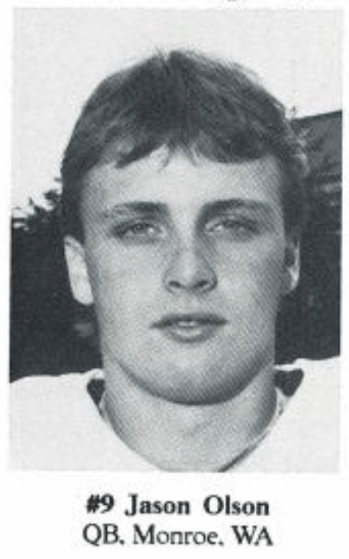
After graduating in 1990, Jason Olson enrolled at the University of Puget Sound and quickly established himself on the football team. Olson became the Logger’s starting quarterback as a Freshman and played in all nine games. The Loggers finished with a 4-5 record and while Olson’s completion percentage and interceptions needed improvement, he still showed promise. He had thrown for 1,435 passing yards and six touchdowns during his debut season.
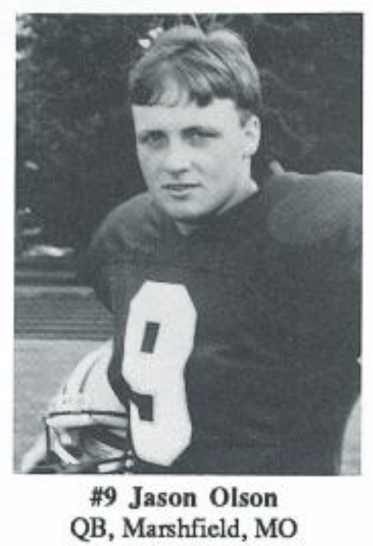
1991 saw the Loggers go 3-5-1 but the season was a step forward for Jason as he became a more efficient passer. He threw for 1,378 passing yards but increased his passing efficiency and also scored 13 touchdowns.[10] Olson’s finest game came against Southern Oregon, a team ranked #15 in the NAIA polls. Though the game ended in a 35-35 tie, Jason threw for 316 yards and completed four touchdown passes to four different receivers.[11]

Despite the Loggers regressing to a 3-6 record, Olson’s Junior season in 1992 was his finest at UPS. Olson passed considerably more than in his previous seasons but had a 50 percent completion rate, the highest of his career.[12] Jason also continued to show off his athleticism by setting a conference record. Against Oregon Tech, Olson rushed 82-yards for a touchdown, the longest rushing play by a quarterback in conference history.[13] His passing yards for the season soared to 1,709 along with 12 touchdowns as he was an honorable mention all-Mount Rainier League.
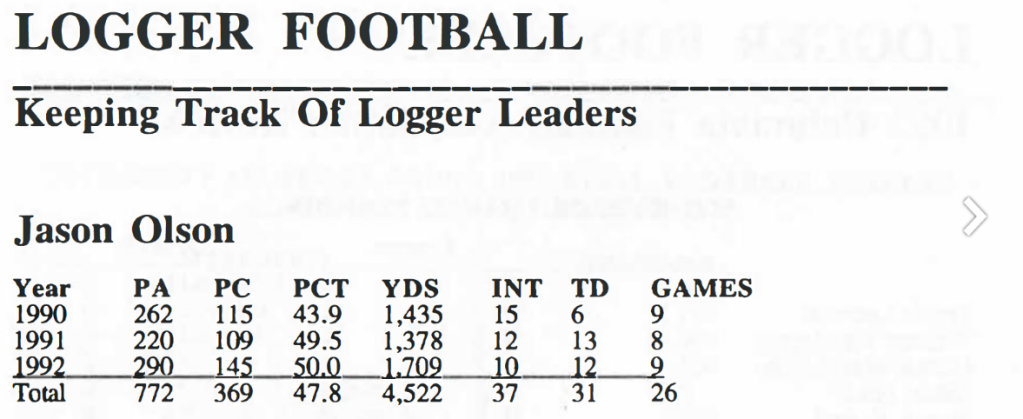
After three seasons, Jason was proving to be one of the best quarterbacks in UPS history. He had thrown for 4,522 yards in his career and was only 32 yards away from eclipsing Ivy Iverson’s school record of 4,554 yards. Nevertheless, Jason did not return for his Senior season. He left UPS before the season began, citing academic reasons for his departure.[14] Despite the abrupt end to his career, Jason Olson’s career is well remembered by fans today. His rare blend of athleticism, passing ability, and pure talent was evident by the records set at every level. His excellence at quarterback ranks him among very best in Monroe High School and University of Puget Sound history.
Sources
[1] “Lake survives at Monroe; Playoffs in sight,” Lake Stevens Journal, October 28, 1987
[2] Homecoming Program, ‘Cat Pac, October 27, 1989
[3] “Monroe knocks out Lake Stevens, 14-12,” Lake Stevens Journal, October 26, 1988
[4] Homecoming Program, ‘Cat Pac, October 27, 1989
[5] “Monroe’s Olson guns down Lake 31-19,” Lake Stevens Journal, October 4, 1989
[6] Washington High School Football Newsletter, Paul Parietti, November 1989
[7] Homecoming Program, ‘Cat Pac, October 12, 1990
[8] Washington High School Football Newsletter, Paul Parietti, November 1989
[9] “Notebook — Olson Leaves UPS Shy Of Record,” The Seattle Times, August 30, 1993
[10] University of Puget Sound Football Prospectus, University of Puget Sound, 1993
[11] Homecoming ’91 Program, University of Puget Sound, October 12, 1991
[12] University of Puget Sound Football Prospectus, University of Puget Sound, 1993
[13] Loggers vs. Lutes Program, Farber News Service, November 7, 1992
[14] “Notebook — Olson Leaves UPS Shy Of Record,” The Seattle Times, August 30, 1993
 The Orange and the Black